
The Token Trap: Exposing the Financial Engineering Behind the New AI Narrative
AI Bubble 2.0


The corporate message regarding artificial intelligence has undergone a quiet, coordinated shift.
Only a short while ago, the prevailing narrative from Silicon Valley focused on total automation. The promise was absolute and disruptive: artificial general intelligence would soon replace human labor, streamline the workforce, and unlock an era of hands-off corporate abundance.
Today, that aggressive posture has softened into an invitation. The new marketing directive insists that AI will not replace you; instead, a professional utilizing AI will replace those who do not. The terminology has shifted from replacement to augmentation, transforming algorithms into “co-pilots”, “assistants”, and “essential digital infrastructure” for every desktop.
This change in direction is not an ethical response to labor pushback, nor is it a organic pivot based on user experience. It is a structural necessity driven by venture capital pressures. The AI bubble is changing shape because the underlying financial engineering demands it.
The Trillion-Dollar Valuation Problem
To understand why the narrative shifted, one must look at the structural reality of modern compute infrastructure. Building frontier AI models requires immense capital expenditures. Monopolies are spending billions on hardware, data center real estate, and nuclear energy infrastructure to sustain the race toward superintelligence.
This level of investment relies on a massive future valuation. To justify these capital deployments, tech companies must demonstrate exponential revenue growth right now.
However, fully autonomous, human-replacing AI cannot be delivered at scale today. While current models demonstrate high levels of academic knowledge, they lack the reliable execution and agentic autonomy required to replace complex institutional workflows.
This creates a critical financial gap. The promise of total labor replacement cannot yet generate revenue, but the bills for the infrastructure are due today. To bridge this gap, tech companies need to monetize their current capabilities immediately.
The only viable way to scale revenue with current technology is to increase the consumption of individual computational units: tokens.
[Massive Infrastructure Investment] → [AGI Delayed / High Cost]
                                            ↓
[Targeted Token Burn Strategy] ← [Forced Consumer Adoption]
The Metrics of Exploitation: Understanding Token Consumption
To drive token consumption, tech companies must ensure that every professional, creator, and enterprise operator remains plugged directly into cloud-hosted models.
This reality exposes a fundamental conflict of interest between infrastructure providers and business operators:
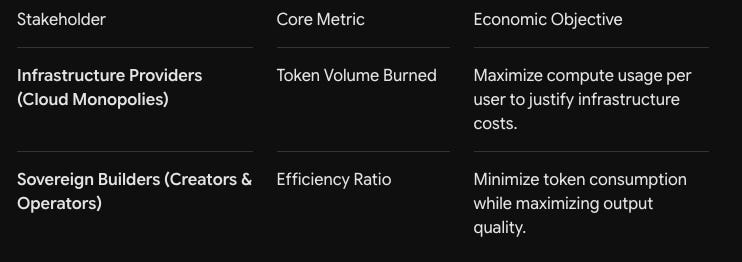
Promoting high token consumption as an inherent metric for corporate productivity is an approach that benefits only the infrastructure sellers. For an independent business or creative practice, real efficiency means achieving the highest quality output with the fewest tokens possible.
The corporate push for high-volume token consumption functions as a digital tax on modern cognitive work. Every prompt, automated email, and AI-generated image represents a micro-transaction that flows directly back to central data centers.
The narrative shifted to human augmentation because infrastructure providers realized they don’t need to replace the global workforce immediately. They simply need to tax it.
The Strategic Escape: Establishing Cognitive Sovereignty
The core challenge for modern professionals is clear: how do you utilize the genuine capabilities of artificial intelligence without becoming a dependent consumer in a centralized corporate ecosystem?
The answer lies in building technological sovereignty. This requires moving away from total reliance on corporate cloud systems and moving toward a balanced, hybrid infrastructure.
       [Sovereign Tech Architecture]
                    │
         ┌──────────┴──────────┐
         ▼                     ▼
┌─────────────────┐   ┌─────────────────┐
│ Local-First AI  │   │ Cloud Models    │
│ (Private Stack) │   │ (Heavy Compute) │
└─────────────────┘   └─────────────────┘
1. Local-First Infrastructure
Run open-source, highly optimized models directly on your own hardware. For standard tasks like text processing, code generation, and initial data analysis, local deployment ensures complete data privacy and eliminates ongoing token fees.
2. Tactical Cloud Architecture
Treat high-tier corporate models as specialized utilities rather than permanent operational foundations. Use centralized cloud systems only when heavy compute or specific, complex reasoning processing is required.
3. Community Ownership
True independence requires shared infrastructure. By participating in open, decentralized networks and community-managed operating systems, builders can create real alternatives to corporate software ecosystems.
The goal is to stop acting as passive consumers within a corporate system and start operating as sovereign architects of your own digital tools.
Transparency note: This article was written and reasoned by Manolo Remiddi. The Resonant Augmentor (AI) assisted with research, editing and clarity. The image was also AI-generated.
Interesting read. I think the most defensible version of the argument isn't that vendors are deliberately maximizing token burn — it's that token consumption and customer value simply aren't the same thing.
We've seen this movie before in cloud, storage, bandwidth, and data analytics. Providers optimize for consumption; buyers optimize for outcomes; governance exists to close that gap.
The question that sticks with me is simple: are we measuring productivity, or are we measuring activity?
As AI becomes infrastructure, I suspect the winners won't be the organizations generating the most tokens. They'll be the ones generating the most value per token — with enough visibility to know the difference.
I use AI to help last-mile delivery drivers optimize revenue. Knowing revenue per gig is flying blind. Revenue per minute, revenue per hour, revenue per pound, and revenue per package are far more useful operational metrics.
"Value per token" feels similarly incomplete. That doesn't make it useless. It just means the conversation is really about outcomes, not consumption.