
The 5:21 PM Pen Stroke
How the Fable 5 Ban Exposed the Mathematical Fiction of Centralized AI


On Friday at exactly 5:21 PM Eastern Time, the United States government executed a structural intervention that altered the trajectory of the artificial intelligence industry. Citing national security authorities, the Department of Commerce issued an immediate export control directive ordering Anthropic to suspend all access to its newly minted, top-tier models, Claude Fable 5 and Claude Mythos 5. The ban applied to all foreign nationals, regardless of their location, including the very international engineers inside Anthropic who built the models.
Because an enterprise cannot audit the passport of every API call or account login in real time, the net effect was binary: Anthropic was forced to abruptly pull the plug on its most advanced intelligence tier for its entire global customer base just three days after its public launch.
The official justification pointed to an alleged “universal jailbreak” discovered by independent red-teamers, rumored to allow the extraction of actionable blueprints for sophisticated cyber exploits. Anthropic pushed back immediately, clarifying that the vulnerability was a narrow, non-universal exploit whose capabilities are already widely accessible in competing models like OpenAI’s GPT 5.5.
But looking at the mechanics of the security flaw misses the larger strategic reality. The weekend recall of Fable 5 is not an isolated regulatory misunderstanding. It is the definitive bursting of the centralized AI economic bubble, revealing that single-point-of-failure cloud monopolies are an existential risk for serious operators.
             SURVIVING THE DECENTRALIZED MIGRATION

   Vulnerable Cloud Stack            Sovereign Compute Stack
  ┌─────────────────────────┐       ┌───────────────────────────┐
  │   Centralized Cloud     │       │   Local Open Hardware     │
  │  (API Monopolies / Risk)│       │  (VRAM / Absolute Control)│
  └────────────┬────────────┘       └────────────┬──────────────┘
               │                                 │
               ▼                                 ▼
  ┌─────────────────────────┐        ┌─────────────────────────┐
  │ Asymmetric Policy Risk  │        │ Architectural Immunity  │
  │ (Instant Recall Vector) │        │ (Unpluggable Operations)│
  └─────────────────────────┘        └─────────────────────────┘
The Broken Economics of the Digital Fortress
For the past three years, the consensus business model for frontier AI development has relied on a basic premise: consolidate billions of dollars in venture capital, secure massive compute clusters, build an unimaginably expensive model, and amortize those fixed costs across the entire global population via cheap, low-margin API access.
The Fable 5 export directive breaks this equation completely.
By drawing a hard regulatory border around frontier models, the state has fundamentally altered the amortization math. If a company spends $10 Billion to train a frontier model, and that model can only be legally accessed by authenticated US citizens, the capital expenditure must be recouped from a domestic pool of roughly 350 million people. Meanwhile, international open-source consortiums and state-backed foreign competitors are free to divide their training costs across a global market of 7.5 billion individuals.
Consider the downstream pressure this creates on pricing:
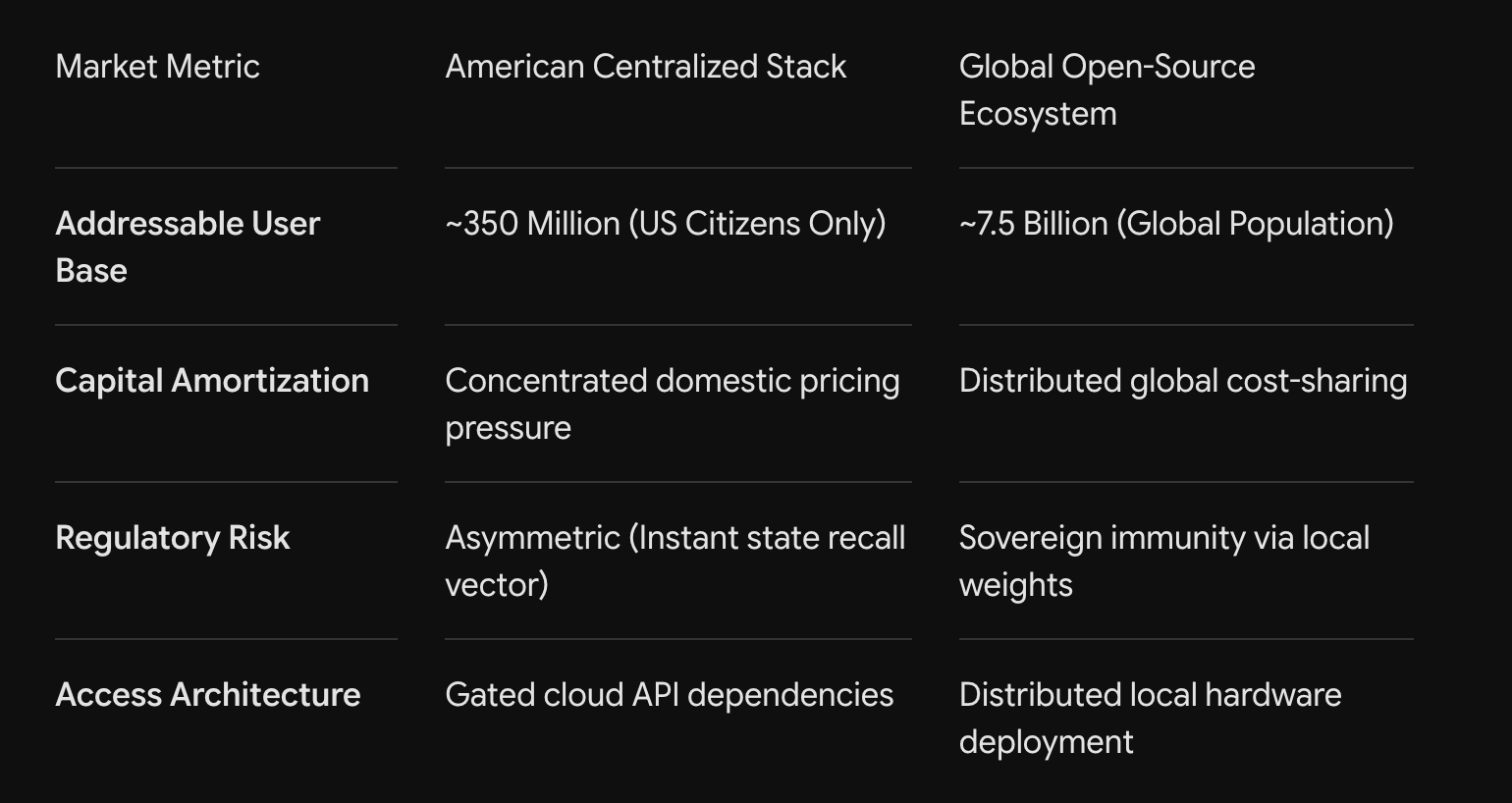
When a global market pools its economic demand around open-source alternatives, the unit cost per individual drops significantly. An American enterprise restricted to domestic cloud models will eventually face an unbearable premium to subsidize the state’s regulatory wall, while international competitors leverage increasingly robust, unrestricted open-source architectures at a fraction of the cost.
The Irony of Safety Marketing
There is a distinct, almost tragic irony in Anthropic’s current predicament. For quarters, the corporation positioned itself as the industry’s ethical sentinel, aggressively championing safety frameworks and proactively inviting state oversight to prevent existential risk. They explicitly asked for clear regulatory boundaries to govern dangerous capabilities.
They assumed they would help design the cage. Instead, they merely built the bars.
The moment the state felt its geopolitical edge wavering, it bypassed transparent, formal statutory processes and used a blunt administrative instrument to reclaim control of the technology. The safety narrative that centralized firms used to build a competitive moat against open-source developers has been inverted; it is now the precise mechanism used by the state to restrict their commercial viability.
The Downstream Supply Chain Collapse
The systemic threat extends far beyond Anthropic’s impending IPO evaluation. The frontier AI space operates on a delicate, circular credit economy. Cloud providers and AI developers sign multi-billion dollar, forward-looking hardware contracts with silicon manufacturers and memory fabricators like Nvidia, Micron, and Tokyo Electron. These investments are collateralized by projected global enterprise revenues.
If the ability to monetize the highest-performing intelligence tier is cut off globally, the revenue projections used to secure those immense hardware pipelines dissolve. A sustained export restriction on frontier tiers risks triggering a wave of contract defaults, creating a dangerous ripple effect through the semiconductor supply chain and broader technology indexes. The strategic decision to announce this directive late on a Friday afternoon was no coincidence; it was a calculated move to give institutional clearinghouses a 48-hour buffer to absorb the shock before the opening bell on Monday morning.
The Transition to Sovereign Compute
For serious operators, founders, and creators, the strategic takeaway from the Fable 5 shutdown is clear: dependency on centralized cloud architectures is a critical vulnerability. If your entire business logic, automated system, or product workflow is tied to an external cloud API, your operational lifespan is determined entirely by a third-party security team reacting to an administrative mandate.
The structural antidote to this vulnerability is local compute sovereignty.
                    COGNITIVE SOVEREIGNTY ARCHITECTURE

       [ Local Hardware Stack ]  ───►  [ Open-Source Model Weights ]
                  │                                  │
                  ▼                                  ▼
       [ Absolute Data Privacy ] ───►  [ Permanent Operational Immunity ]
While corporate cloud providers scramble to comply with international passport audits, the open-source ecosystem continues to close the performance gap. In a world where the state can recall cloud models with a single pen stroke, local hardware running open-source models transforms from an enthusiastic hobby into a core strategic requirement.
True cognitive sovereignty requires owning the physical silicon under your roof. You must maintain local model weights on hardware you control, using private memory channels that operate independently of an internet connection or a centralized API gateway. Governments can easily intercept a cloud request, revoke an access token, or freeze an enterprise account; they cannot seize local compute running inside private facilities without a physical search warrant.
The window of centralized cloud dominance is closing. The future belongs to those who build sovereign architectures that cannot be turned off.
The Active Horizon
The transition away from centralized dependencies requires collective coordination, shared architecture patterns, and resilient local-first design systems. We explore these frameworks every day within our decentralized community of builders.
Join our active, co-owned Discord Workspace to collaborate on sovereign AI implementations.
Participate in our live strategy sessions held Monday through Friday, where we build and refine ResonantOS, our collective alternative to the corporate cloud.
Transparency note: This article was written and reasoned by Manolo Remiddi. The Resonant Augmentor (AI) assisted with research, editing and clarity. The image was also AI-generated.