
The 14-Day Arbitrage: How to Build Sovereign Systems Before AI Prices You Out
Corporate tech platforms are building a massive financial moat around frontier intelligence. Here is a practical counter-strategy for independent operators.


The economics of frontier artificial intelligence are shifting beneath us. We have entered a transitional phase where the primary bottleneck is no longer raw capability, but operational sustainability. The release of recent large-scale models marks a clear departure from the accessible, flat-rate consumer software experiments of the past few years. We are seeing the arrival of industrialized, capital-intensive computation designed for the corporate balance sheet.
For independent builders, creative directors, and technical operators, this shift introduces an immediate structural threat: the real possibility of being priced out of top-tier intelligence.
However, this transition has created a temporary operational window.
By understanding the business logic of these platform shifts, we can turn a corporate dependency strategy into an architectural advantage.
The Reality of the Computational Moat
For over a year, regular updates to mid-tier models offered minor, incremental improvements. A small efficiency gain here or a slightly cleaner output there was rarely enough to alter a developer’s daily workflow.
The newest generation of large-scale models breaks that plateau by scaling up raw parameters. The difference in processing depth is clearly noticeable, but it comes at a significant cost.
[Frontier Infrastructure Scaling] ---> [Massive Capital Expenditure] ---> [Enterprise API Pricing] ---> [Individual Builder Exclusion]
This evolution relies on sheer scale. Corporations are securing massive data center partnerships to run large models that require immense token consumption for deep reasoning tasks. This approach creates a natural financial barrier to entry.
When these models transition exclusively to API access, daily operational costs for complex workflows can easily run into hundreds of dollars. For large corporations, this expense is a minor line item in a broader efficiency budget. For an independent studio or small startup, it can quickly erode profit margins.
The Mechanics of the Dependency Trap
Platform providers understand that users adapt to heightened cognitive capabilities very quickly. Once a team integrates a deep-reasoning model into its daily engineering or design pipelines, reverting to a lower-tier alternative feels like a significant operational step backward.
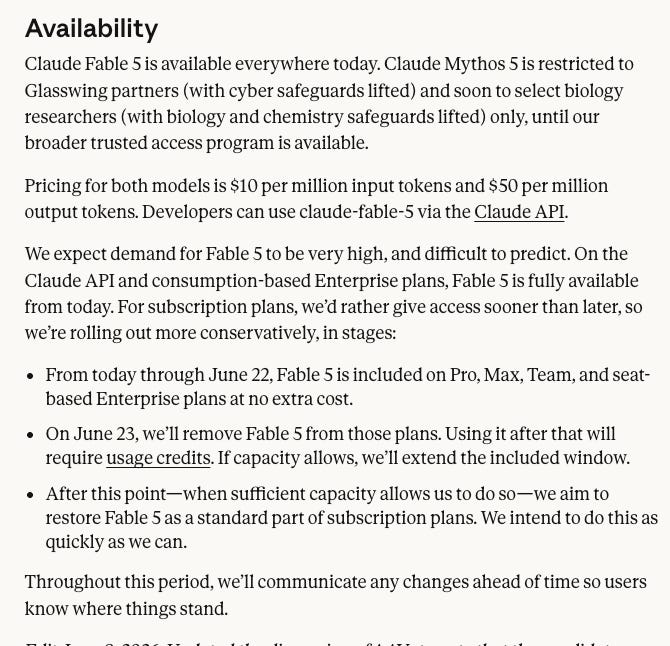
This reality explains why Anthropic introduces brief, flat-rate subscription access windows before moving models exclusively to metered APIs:
Behavioral Lock-in: Fourteen days is the ideal operational window to form a habit. It is long enough to embed a tool into an active project, but short enough to prevent long-term, low-cost usage.
Value Realization: Users quickly build workflows around these advanced capabilities, making the high cost of later API bills feel necessary rather than optional.
The Transition Moat: By the time the flat-rate access window closes, your product architecture is tied to an infrastructure layer you no longer cost-effectively control.
This is a classic platform play. However, understanding this mechanism allows you to approach the subscription window as a strategic asset rather than a consumer trap.
The Counter-Strategy: Architectural Arbitrage
Instead of letting a platform lock you into their ecosystem, you can treat this brief subscription window as a highly subsidized development phase. Use the advanced model as an outsourced chief architect to build systems that can ultimately run without it.
The strategy requires a fundamental shift in how you prompt and structure your systems. You must explicitly instruct the frontier model to design code and workflows that can be managed by much smaller, cost-effective local systems.
+--------------------------------------------------------+
|               FRONTIER MODEL (Fable 5)                 |
|       Used only during subsidized 14-day window        |
+--------------------------------------------------------+
                           |
                           v  [Architectural Output]
+--------------------------------------------------------+
|            DECOUPLED, MODULAR ARCHITECTURE             |
|   Clean documentation & small, isolated code blocks     |
+--------------------------------------------------------+
                           |
                           v  [Long-term Execution]
+--------------------------------------------------------+
|               SMALLER / LOCAL MODELS                   |
|          Runs sustainably and cost-effectively         |
+--------------------------------------------------------+
1. Enforce Absolute Modularity
Do not allow the model to generate sprawling, interconnected files that require a massive context window to comprehend. Force it to write code in clean, isolated blocks. Each module must perform a single, clearly defined function with explicit inputs and outputs.
2. Generate Rigid System Documentation
Use the model’s advanced reasoning capabilities to write comprehensive technical documentation for every module it creates. This documentation should act as an explicit set of instructions that explains the precise role of each block.
3. Design for Lower-Tier Processing
Include clear constraints in your system architecture prompts. Use instructions like: “This subsystem must be written so that a smaller open-source model can easily analyze, maintain, and modify it without needing broader project context.”
Active Adaptation and Cognitive Sovereignty
This approach reflects the core principles of active adaptation. It rejects the passive reliance on corporate cloud ecosystems in favor of building long-term tactical flexibility.
By using high-tier models strictly for initial system design and structural engineering, you extract their core value without taking on recurring infrastructure liabilities. Once your project’s architecture is clearly established and broken down into manageable blocks, you can safely migrate daily maintenance and feature expansion to local hardware or affordable open-source alternatives.
The choice is clear: you can either let these systems build habits that make you dependent on their infrastructure, or you can use their structural shift to build a more resilient, sovereign tech stack. Treat the next fourteen days as a targeted development sprint. Build your systems carefully, document them thoroughly, and ensure they remain completely decoupled from the platform that helped create them.
Transparency note: This article was written and reasoned by Manolo Remiddi. The Resonant Augmentor (AI) assisted with research, editing and clarity. The image was also AI-generated.